
There’s a lot of discussion about home education in the media, and much of it focuses on children with special educational needs and disabilities (SEND), school anxiety or families who feel the education system has let them down.
These are important stories, and for many families, home education has provided a much-needed alternative when mainstream school hasn’t worked.
But there’s another side to home education that receives far less attention.
What about families whose children are happy, developing well and have no additional educational needs, but whose parents simply want something different?
Home education isn’t always a last resort. Sometimes it’s a positive, deliberate choice.
Home education is more diverse than you might think
According to the Department for Education’s autumn 2025 statistics, approximately 126,000 children were being electively home educated in England.
Of those children, 16% were recorded as receiving SEN support and 7% had an Education, Health and Care Plan (EHCP). These figures don’t capture every child with additional needs, but they do challenge the idea that home education is exclusively associated with SEND.
Parents also reported philosophical preferences, lifestyle choices and general dissatisfaction with schools as reasons for educating their children at home.
A 2022 survey by Education Otherwise found that 40% of the 3,168 parents responding considered providing a better education to be their main current reason for home educating. Although this wasn’t a representative survey of all home-educating families, it offers another perspective on why parents make this choice.
Why we chose home education
For our family, the decision wasn’t driven by additional educational needs, school anxiety or an unhappy experience in the classroom.
Like most parents, we assumed our children would go to school. We both worked full-time, and we hadn’t really considered that there might be another option.
But once they started school, we found ourselves caught up in the daily routine of rushed mornings, school runs, work, dinner and bedtime. Weekends seemed to disappear just as quickly.
We began to question how little time we actually had together.
We wanted to play a bigger role in our children’s upbringing, not just squeeze family life into the hours left over after school and work.
And we’d already discovered how much children could learn through ordinary family moments.
I remember my husband explaining black holes to the children when they were around six years old. He used their duvet at bedtime to represent the fabric of spacetime, showing how a massive object could distort it.
No textbook, no formal lesson. Just a bedtime conversation about one of the most fascinating ideas in physics.
At primary school, children learn that gravity causes objects to fall towards Earth. More complex explanations involving gravitational fields and the curvature of spacetime come later in their education.
But why should a curious six-year-old have to wait to explore those ideas?
They don’t need to understand the equations to begin thinking about how the universe works.
That little bedtime conversation captured something we valued: the freedom to explore big ideas whenever curiosity strikes, regardless of a child’s age or what’s on the curriculum.
We didn’t think school was bad. We simply wanted more opportunities for moments like these, and more time to be actively involved in our children’s learning and development.
The difficulty was that we both worked full-time, so home education didn’t seem possible.
Then lockdown happened, and everything changed.
Can you home educate while working full-time?
Lockdown gave us an opportunity we hadn’t previously considered.
We were both able to work from home. Neither of us was furloughed, and we continued working throughout, but suddenly the idea of home education became realistic.
Our children were six and eight at the time, so we needed an approach that didn’t require us to sit beside them teaching every lesson.
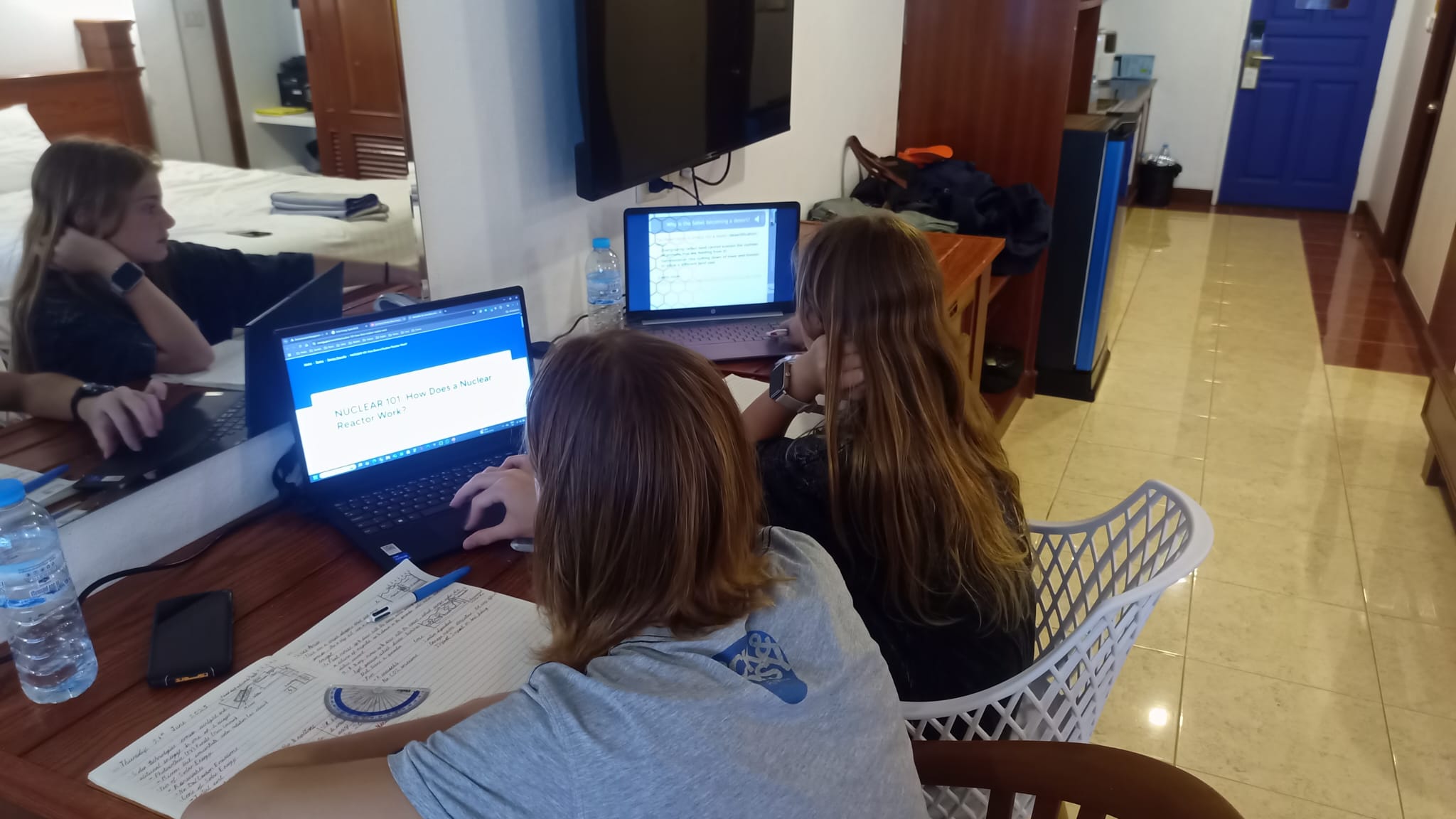
We used structured online learning platforms that allowed them to study independently, with guidance and support from us when needed.
They learnt to manage their work, tackle problems and take increasing responsibility for their learning.
We didn’t attempt to recreate a classroom at home, and we didn’t need to.
Doing things differently, not necessarily making life harder
One misconception is that home-educating parents must personally teach every subject and organise activities throughout the day.
That hasn’t been our experience.
We made use of online resources, educational platforms and activities outside the home.
Because we both worked, we attended fewer daytime home education meet-ups than some families. Instead, our children joined activities such as an after-school swimming club.
Children educated at home can also access sports clubs, specialist tutors, workshops, museums, community groups and extracurricular activities. Some opportunities are specifically organised for home-educating families.
Working and home educating requires organisation, but so does working while managing school runs, homework, inset days, school holidays and after-school commitments.
For us, it wasn’t necessarily harder. It was a different arrangement that suited our family better.
Learning at a child’s own pace
In a classroom, even the most dedicated teacher has to balance the needs of many children.
Home education allows learning to be much more individual.
A child who grasps a maths concept quickly can move forward without waiting for the rest of the class. Another who needs longer to understand fractions can spend the time getting comfortable with them.
There’s no requirement to move on simply because the timetable says so.
And children don’t necessarily progress at the same speed in every subject. Someone might be working several years ahead in maths while developing their writing skills more gradually.
Home education makes it easier to accommodate those differences without constantly measuring a child’s progress against that of their classmates.
There are also plenty of excellent free resources available. We’ve put together a collection of our favourite free online maths resources for home educators, covering everything from primary maths to IGCSE preparation.
Following curiosity, not just a curriculum
Children are naturally curious, but their interests don’t always fit neatly into a timetable.
A fascination with ancient Egypt might lead to reading, archaeology, geography and museum visits. An interest in gaming could develop into programming, digital design or learning about how computers work.
Rather than treating these interests as distractions, home education allows families to make them part of learning.
That doesn’t mean abandoning academic subjects or avoiding things children find difficult.
It means recognising that education can be broader than a prescribed sequence of lessons, and that enthusiasm is a powerful starting point.
More time for life beyond academic subjects
Education is about more than passing examinations.
Cooking, managing money, travelling independently, communicating with people of different ages and learning to solve everyday problems are all valuable skills.
Home education can make these experiences a natural part of daily life.
A trip to the supermarket provides opportunities to compare prices and understand budgets. Planning a journey involves research, decision-making and practical responsibility.
And not every experience needs to become a formal lesson. Sometimes children learn simply by being involved in everyday family life.
For families who want to travel, home education can also provide greater flexibility to explore new places without being restricted to school holidays.
Museums, historical sites, different cultures and everyday experiences can all contribute to an education.
What about socialising?
One of the first questions home-educating families hear is: "But what about socialisation?"
It’s a reasonable question, but it often assumes that school is the only place children develop friendships and social skills.
Home-educated children meet others through sports clubs, activity groups, workshops, volunteering, community events and home education meet-ups.
These opportunities can bring children together across different ages, rather than limiting most daily interactions to children born within the same academic year.
Of course, friendships still need time and regular contact to develop. Families may need to make a conscious effort to provide those opportunities.
But home education doesn’t mean growing up in isolation, and socialising doesn’t have to happen exclusively during school hours.
If socialisation is something you’re concerned about, we’ve explored the research and practical opportunities in our article on socialisation in home education.
What about qualifications and future opportunities?
Choosing home education doesn’t mean abandoning academic ambitions.
Home-educated children can work towards GCSEs, IGCSEs and other recognised qualifications, although families generally need to arrange and pay for private examination entries themselves.
Some children take examinations earlier than their school-educated peers, while others spread qualifications across several years or pursue different routes into further education.
Home education doesn’t guarantee academic success.
But neither does school.
Children can thrive academically in either environment, and they can struggle in either.
What home education offers is the flexibility to adapt learning to individual abilities, interests and ambitions.
The important thing is understanding the requirements for future opportunities, particularly where specific qualifications are needed for college, university or a chosen career.
Home education isn’t one-size-fits-all
There’s no single correct way to home educate.
Some families follow structured curricula and use online learning platforms. Others prefer project-based learning, autonomous education or a mixture of approaches.
Some parents are at home throughout the day. Others work, arrange their schedules differently or share responsibilities.
Some families attend several home education groups each week. Others prefer established clubs, independent activities and a smaller circle of friends.
The flexibility to find an approach that works for your family is one of home education’s greatest strengths.
That doesn’t mean it’s right for everyone. Families need to consider their circumstances, resources and responsibilities.
But it does mean there are more possibilities than many parents initially realise.
Home education can be a first choice, not a last resort
Families whose children have SEND deserve appropriate support, whether their children attend school or are educated at home. Their experiences are an important part of the home education conversation.
But they aren’t the only families who choose this path.
Some parents want more time with their children. Others value individualised learning, independence, greater flexibility or the opportunity to explore interests in depth.
And some, like us, simply discover that the conventional school routine isn’t how they want to spend their children’s childhood.
A child doesn’t have to struggle at school, have additional needs or be unhappy for their parents to consider home education.
Sometimes the question isn’t "Why can’t my child go to school?"
It’s "What kind of education and family life do we want to create?"
And that’s a perfectly good reason to explore the alternatives.
If you’re considering making the change, our guide to starting home education in England explains the practical first steps.